
CFIA 2026: let’s meet to discuss food safety challenges
From 10 to 12 March, our team will be at CFIA Rennes, one of the…
Read more
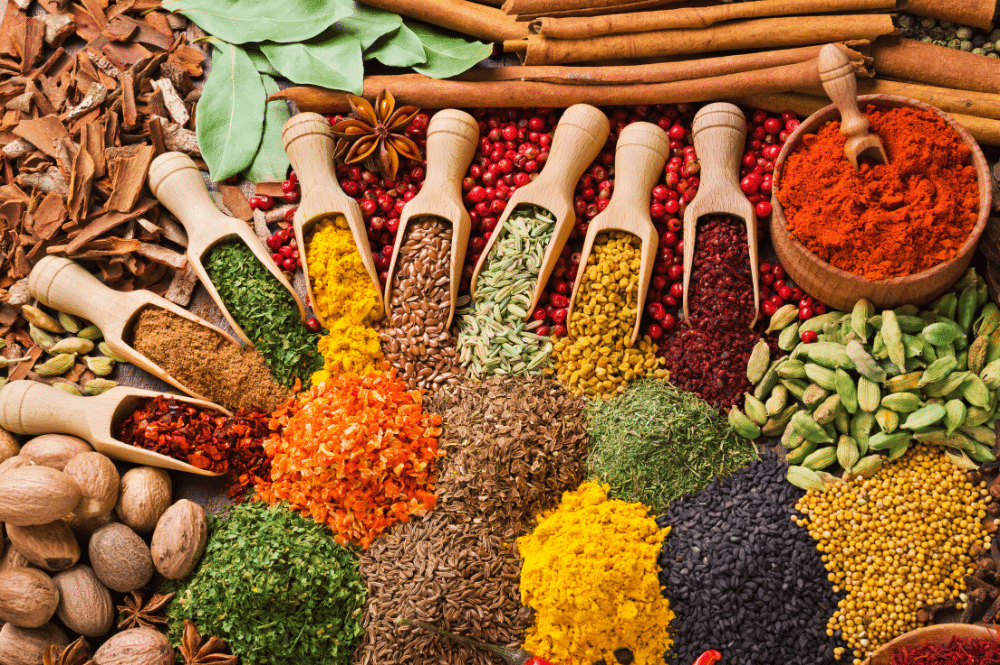
Spices are flavouring and aromatic substances of plant origin, but they can be pungent and come from different parts of plants: bark, flowers, leaves, fruit, bulbs and seeds. Unlike herbs, they are often obtained after drying or processing. Most originate from the East and were brought to Europe over the years, making them much rarer than herbs.
A few examples:
Herbal infusion plants, such as tea, herbal teas or plant blends, are natural products whose quality can be influenced by their origin, growing conditions, harvesting, drying, storage or transport. They may also be exposed to various risks, such as chemical contaminants, microbiological contamination or species substitution, which can affect their quality and compliance.

Due to their nature and production methods, dry products (spices and teas) are particularly exposed to several types of chemical contamination:
To guarantee the compliance of your products and protect your consumers, we help you:
Innovation & Methods
We offer analyses to check the regulatory compliance of your foodstuffs.
Botanical identification according to pharmacopoeias
(legally binding regulatory reference standard = genuine legal value).
We carry out a macroscopic analysis, study organoleptic properties, and perform a microscopic analysis and chemical fingerprinting (TLC or GC depending on the plant).
Water content (loss on drying or azeotropy), essential oil content, total ash, acid-insoluble ash.
Microbiology according to the European Pharmacopoeia (chapters 2.6.12; 5.1.4 and 5.1.8).
lead, cadmium, arsenic, mercury…
dithiocarbamates and related families, glyphosate, chlorates, ethephon, fosetyl aluminium, maleic hydrazide…
ochratoxin, aflatoxins…
walnut, cashew, pecan, macadamia, Brazil nut, almond, hazelnut, peanut and pistachio, celery.
carbohydrates, sugar profile, total fat, protein, ash, dry extract.

Our regulatory team supports you in assessing the compliance of your products by carrying out daily monitoring of applicable regulations and directives, draft texts and standards.
Our experts Céline and Aurélie are here to help.

A comprehensive quality audit to assess your production practices and ensure the compliance of your products. Our experts will provide tailored recommendations to optimise your processes and reduce risks.

We help you set up effective traceability systems to ensure transparency throughout the cereal production chain. You can track each batch from cultivation to final use.
Testimonial
Whether you are a producer, buyer or project manager,
we help you ensure the quality, safety and compliance of your products at every stage.
Our spices come from different regions of the world and we must guarantee our customers authentic, compliant products. The analyses carried out by Phytocontrol allow us to check the quality of our peppers, cinnamons, saffrons and other spices, while detecting any fraud or adulteration. Their expertise gives us real peace of mind and strengthens our customers’ trust


+1,000 satisfied customers

Research and expertise
We drive your projects forward with tailor-made solutions and close support. Technical expertise, full traceability and rigorous compliance: we turn your constraints into performance levers.
Our experts are committed to helping you:
ACCREDITATIONS
Phytocontrol is accredited by COFRAC and has one of the most extensive and comprehensive accreditation scopes for analysing the quality of your products.


Questions about our analyses or your project?
Our advisors respond within 24 hours. Tell us what you need.
support
We support you from order to delivery of results.
We offer 3 levels of support:
Featured
Everything you need to know, at the right time, for your business.
From 10 to 12 March, our team will be at CFIA Rennes, one of the…
Read more
The problem Chlorates are pesticides belonging to the herbicide category. They have been banned in…
Read more
Phytocontrol has developed and accredited gluten analysis using the ELISA method across a wide range…
Read moreThe Total Diet Studies (EAT) are national studies aiming to measure the levels of food…
Read more
The European Commission has just authorised 7 GMOs and renewed 2 authorisations: GHB614 x LLCotton25…
Read moreProving its specific expertise in pesticide testing and the reliability of its know-how, Phytocontrol has…
Read more
Phytocontrol offers technical information and discussion mornings on a range of topics. Importance of quality…
Read more
Phytocontrol offers technical morning sessions for information and discussion on a range of topics. Importance…
Read more
Phytocontrol offers technical morning sessions for information and discussion on a range of topics. Food…
Read more