What is a metabolite ?


A phytosanitary solution consists of one or more active ingredients and inert elements. During a treatment, some active ingredients degrade totally or partially into another molecule called “metabolite”.
Metabolites are formed as a result of chemical reactions occurring through metabolism of the plant, pests or soil.
The Regulation (EU) 396/2005 setting Maximum Residue Limits (MRLs) is constantly evolving and incorporates metabolites into pesticide residue definitions when necessary.For example, the residue definition of 2-Phenylphenol has been limited to this molecule. Following the publication of Regulation (EU) 2018/78, the residue definition relates “2-phenylphenol (sum of 2-phenylphenol and its conjugates, expressed as 2-phenylphenol)”.
According to LAB GTA 26 (Technical Accreditation Guide for Pesticide Residues prepared by COFRAC), accredited laboratories are required to submit analytical results in accordance with regulatory requirements.
The analytical result shall be reported in accordance with the regulatory residue definition and in the case of complex residue definitions involving more than one molecule, each of which shall be reported individually on the analytical report.
Appendix B of the SANTE/12682/2019 Guidance document on analytical quality control and method validation procedures for pesticide residues and analysis in food and feed, in force since 1 January 2020, provides examples of residue definitions incorporating metabolites and how they are taken into account in the analytical result.
Below you will find the link to the corresponding SANTE/11312/2021 document:
Document SANTE/11312/2021
For example, consider the current residue definition of Flonicamide:”Flonicamide: sum of flonicamide, TFNA and TFNG expressed as flonicamide”. Below you will find a description of the parent molecule and its two regulated metabolites:
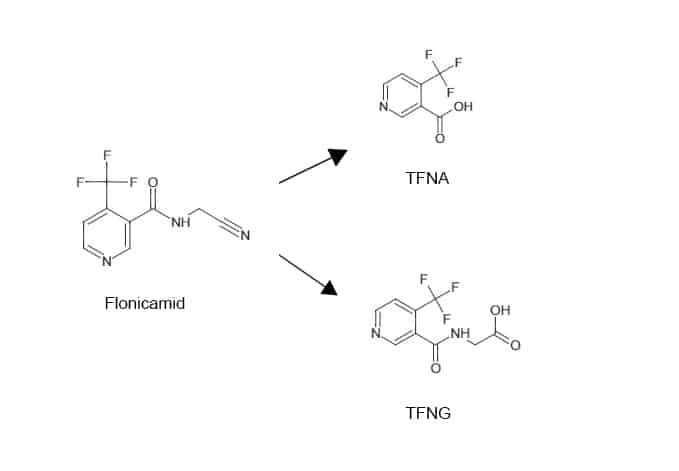
Our Regulatory Department, in collaboration with our R&D Department, ensures that each change in residue definition is included in your analysis reports, in compliance with the deadlines required by European regulations.

