Detection of perfluorinated compounds (PFAS) in water

Phytocontrol supports you in the detection and quantification of per- and polyfluoroalkyl substances (PFAS) using its state-of-the-art technology and COFRAC-accredited method, in drinking water, raw water, atypical water and wastewater.
Phytocontrol meets the regulatory requirements for 20 PFAS in water intended for human consumption, 7 PFAS in freshwater and PFOS in wastewater.
These perfluorinated compounds are as follows: PFOS, PFOA, PFBS, PFPeS, PFHxS, PFHpS, PFNS, PFDS, PFUdS, PFDoS, PFTrDS, PFBA, PFPeA, PFHxA, PFHpA, PFNA, PFDA, PFUdA, PFDoA, PFTrDA.
Definition of PFAS, also known as “forever chemicals”
The perfluorinated and polyfluorinated compounds are widely used in industry, with over 4,700 molecules, for their non-stick, waterproof, stain-resistant and heat-resistant properties. They are found in particular in textiles, food packaging, cosmetics, plant protection products, kitchen utensils, varnishes, and many other products.
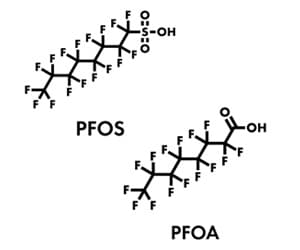
PFAS have very stable carbon-fluorine bonds, resulting in very low degradation and an increased presence in the environment. The PFOS and PFOA subfamilies are the best-known and most persistent perfluorinated substances in the environment.
PFAS: toxic to the environment and health
Per- and polyfluoroalkyl compounds are not broken down in the human body and bioaccumulate, thereby increasing health risks: high cholesterol, increased risk of breast, kidney and testicular cancer, disruption of liver function, hypothyroidism, risk of miscarriage, fertility problems, weakened immune system…
There are also environmental risks, with contamination of water, contamination of wildlife and flora, and rapid, long-lasting spread in the environment.
What does the regulation say about PFAS?
For water intended for human consumption, under the order of 31 December 2022 amending the order of 11 January 2007 on quality limits and reference values in drinking water, a quality limit of 0.1µg/L is set for the sum of 20 PFAS. Regarding environmental analyses, French regulations impose limits of quantification for 7 PFAS in freshwater and 1 PFAS in wastewater.
Water intended for human consumption: Directive (EU) 2020/2184 on the quality of drinking water sets a parametric value for:
- Total PFAS = 0.50 μg/L
- Sum of PFAS = 0.10 μg/L (sum of the 20 per- and polyfluoroalkyl substances of concern, listed in Annex III part B point 3 of the directive).
Environmental water: regulations set an LOQ of 0.002 μg/L for 7 PFAS in freshwater: PFHxA, PFHpA, PFOA, PFDA, PFHxS, PFOS, PFDS).
Wastewater: Environmental LOQ notice for wastewater: 0.05 µg/L for PFOS.
What is the Phytocontrol solution for analysing PFAS in water?
Drawing on its expertise in organic contaminants in water, our Phytocontrol laboratory meets regulatory requirements and offers analysis of 25 perfluorinated compounds (PFAS) in freshwater, raw water, atypical water (carbonated and highly mineralised) and wastewater.
Of these 25 compounds, 20 PFAS are regulated in drinking water; the other 5 are alternatives used by manufacturers (PFTeDA, GenX, 4:2 FTS, 6:2 FTS and 8:2 FTS) and are offered as a complement to the range. Phytocontrol also offers analysis of the 7 PFAS regulated in freshwater and PFOS for wastewater.
Our method is COFRAC-accredited for all types of water (drinking water, raw water, atypical water and wastewater) and is carried out by direct injection LC-MS/MS, guaranteeing a fast turnaround time of 6 days while respecting our eco-responsible approach: low use of solvents, dissolving agents and plastics.
Need technical, regulatory or pricing information? Our customer service is available from 8am to 7pm, Monday to Friday.
To stay up to date with Phytocontrol news, join us on our LinkedIn page!

